It's just a month now until the 12th Molly Murphy novel comes out. It's called The Family Way and it deals with the meaning of family on many levels (as well as being a really suspenseful mystery).
So to build up to March 5, I'm doing a series of blogs on the real Molly Murphys of the ealy 20th Century--women who defied all odds and did amazing things. And today I'm starting with the real life investigators.
So many people have said to me that Molly couldn't possible do the things I have her do. No woman at that time could be a detective. Aha--well I love to prove them wrong. My first true life example is Isabella Goodwin. Mrs Goodwin was a police matron in New York City, married to a policeman who died. The police department started using her for under cover surveillance and she proved to be so good at it that she became a fully fledged police detective, the first of two women detectives on the squad at that time. I've seen her uniform at the police museum in New York. How anybody could run after crooks with that high neck, tiny waist, tight sleeves I've no idea! But I was so impressed with her that she comes into several of my books.
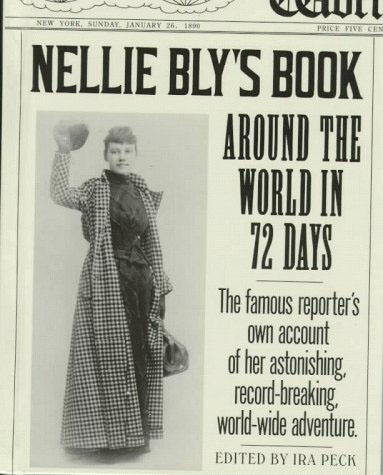
My other shining example of what a woman could do at that time is NELLIE BLY Born Elizabeth Jane Cochran to a working class family she came to the attention of a newspaper editor when she wrote a scathing rebuttal to a letter in the Philadelphia newspaper. He hired her first to write a column then he started sending her out to do investigative reporting. When she was sent to Mexico to cover the election there she was a little too probing into corruption and had to be whisked home to save her life.
Back home she moved to the New York World. She became famous for beating Jules Vernes fictional Around the World in 80 days. She did it in 72 and reported it all to her newspaper who saw their circulation soar as a result. Other remarkable feats: she got herself committed to an insane asylum to report on the terrible conditions there, also had herself arrested so that she could report on the conditions in the women's prison. She was so well respected as a reporter that she was the only woman reporting back from the front in WWI.
Helpless females? I don't think so.
News and musings from New York Times bestselling mystery writer Rhys Bowen, creator of the Royal Spyness and Molly Murphy mysteries. Sparkling British royal comedies and atmospheric historical drama.
Showing posts with label Nellie Bly. Show all posts
Friday, February 1, 2013
Monday, April 4, 2011
How real is Molly--part deux.
Continuing my thoughts on Molly Murphy, my turn of the century heroine sleuth.
During the course of this series I have received non-fan letters telling me that what Molly does is just not possible for a woman of the time.
I'm told no woman could be a detective or undertake Molly's risky assignments when women were delicate creatures who fainted and stayed at home, taking care of children. I'm always delighted to disprove these statements. First--history is written by men. Women were never delicate creatures, except in the minds of their menfolk. Look at the women who walked behind wagons across the continent, often giving birth along the way. Nothing delicate there. And at that time women were mounting expeditions to the North Pole (Louise Boyd), riding across Arabia disguised as a man (Lady Hester Stanhope), discovering uranium (Marie Curie) and pretty much doing anything a man can do... only not always getting the credit for it.
But Molly is actually modeled on two women in particular:
Sabella Goodwin was a police matron when the NYPD started using her for undercover surveillance. She proved so good that she was promoted to full detective by 1910. One of two women to be police detectives when Molly was operating. She appears in my books and I have seen her uniform in the police museum.
The other model was Nellie Bly, the fearless female reporter who took incredible risks to expose corruption and injustice. She had herself locked in a mental asylum so that she could report on abuses there, arrested so that she could report on women's prisons. Her most famous achievement was going around the world in 72 days, thus shattering the record of the famous book. While reporting on an election in Mexico probed too deeply and she had to be whisked back to the states with a price on her head. In 1914 she was the only female reporter at the front in WW1.
So Molly is in good company. We'll have to see whether marriage actually cramps her style or not. I rather think not.
During the course of this series I have received non-fan letters telling me that what Molly does is just not possible for a woman of the time.
I'm told no woman could be a detective or undertake Molly's risky assignments when women were delicate creatures who fainted and stayed at home, taking care of children. I'm always delighted to disprove these statements. First--history is written by men. Women were never delicate creatures, except in the minds of their menfolk. Look at the women who walked behind wagons across the continent, often giving birth along the way. Nothing delicate there. And at that time women were mounting expeditions to the North Pole (Louise Boyd), riding across Arabia disguised as a man (Lady Hester Stanhope), discovering uranium (Marie Curie) and pretty much doing anything a man can do... only not always getting the credit for it.
But Molly is actually modeled on two women in particular:
Sabella Goodwin was a police matron when the NYPD started using her for undercover surveillance. She proved so good that she was promoted to full detective by 1910. One of two women to be police detectives when Molly was operating. She appears in my books and I have seen her uniform in the police museum.
The other model was Nellie Bly, the fearless female reporter who took incredible risks to expose corruption and injustice. She had herself locked in a mental asylum so that she could report on abuses there, arrested so that she could report on women's prisons. Her most famous achievement was going around the world in 72 days, thus shattering the record of the famous book. While reporting on an election in Mexico probed too deeply and she had to be whisked back to the states with a price on her head. In 1914 she was the only female reporter at the front in WW1.
Subscribe to:
Posts (Atom)